Leon Zay · June 16, 2026 · 7 min read
Video outreach in 2026: how to get more replies and book more meetings
Learn how personalized video outreach works, why it outperforms text-only cold email, and how AI lets you scale it across thousands of prospects.
Cold email reply rates are falling. A 2025 study by Belkins found the average cold email reply rate dropped from 6.8% to 5.8% year-on-year in 2024, with further declines in 2025. Text-based outreach is getting noisier, inboxes are getting fuller, and buyers have learned to ignore anything that looks templated.
Video outreach does something different. A prospect sees a real face, hears a real voice, and immediately feels like the message was sent specifically to them. That perceptual shift changes behavior. According to Vidyard's research, 63% of sales professionals report that using video messaging directly increases their response rates. Separate data from SyncGTM found that teams using personalized video outreach see 25% higher reply rates than text-only cold email sequences.
The challenge has never been whether video works. It's whether you can do it at scale.
Used by sales teams running modern outreach






Why most teams abandon video outreach after week two
The standard approach goes like this: an SDR records a bespoke video for each prospect, writes a personalized intro, uploads it, and embeds it in an email. For one or two prospects a day, that's fine. For fifty, it's unsustainable. Recording and sending a genuinely personalized video can take fifteen to thirty minutes per prospect. Multiply that across a full sequence and most reps give up before the approach has had a chance to prove itself.
The other common mistake is sending a generic video with a personalized subject line. Prospects notice the mismatch immediately. A video that starts with "Hi, I wanted to share something with your team" lands no better than a cold email that begins with "I came across your LinkedIn profile."
Neither problem is a reason to abandon video outreach. Both are reasons to rethink how it gets made.
What makes a video outreach message actually work
Good video outreach has three components that most text-based messages lack: visible personalization, a human face, and a clear, low-friction ask.
Visible personalization means the prospect can see, within the first few seconds, that this wasn't sent to a list. Mentioning a specific LinkedIn post, a recent funding round, a new hire, or a product launch signals genuine research. AI-driven platforms now pull these signals automatically, so reps don't have to spend twenty minutes on manual research per contact.
A human face creates trust before a word is spoken. Emails with a video thumbnail featuring a real person's face average a 10.3% click-through rate compared to 6.1% for standard static images, according to 2026 data from Stripo. Animated GIF thumbnails perform even better, with some studies showing 42% to 88% higher click rates versus static alternatives.
A clear ask keeps the friction low. The video should end with one specific next step: book a call, reply with a yes or no, watch a two-minute demo. The more ambiguous the CTA, the less likely the prospect is to act.
The case for keeping videos short
Longer isn't more persuasive. According to Vidyard, 65% of viewers watch a business video to completion if it's under 60 seconds. Drop that to 30 seconds and completion rates rise further. Anything over 90 seconds risks losing the viewer before the ask even arrives.
A practical formula: open with the prospect's name and a specific reference (ten seconds), explain the relevant context or problem you've spotted (twenty seconds), make the ask (ten seconds). That's under a minute and covers everything that matters.
How AI changes the video outreach equation
The scalability problem is largely solved now. Platforms that combine AI prospect research with voice and face cloning let sales teams record one base video, then auto-generate personalized versions for every prospect on a list. According to data from Sendspark, teams using AI-personalized video outreach report a 200–300% increase in email response rates and book 40–50% more meetings compared with text-only sequences.
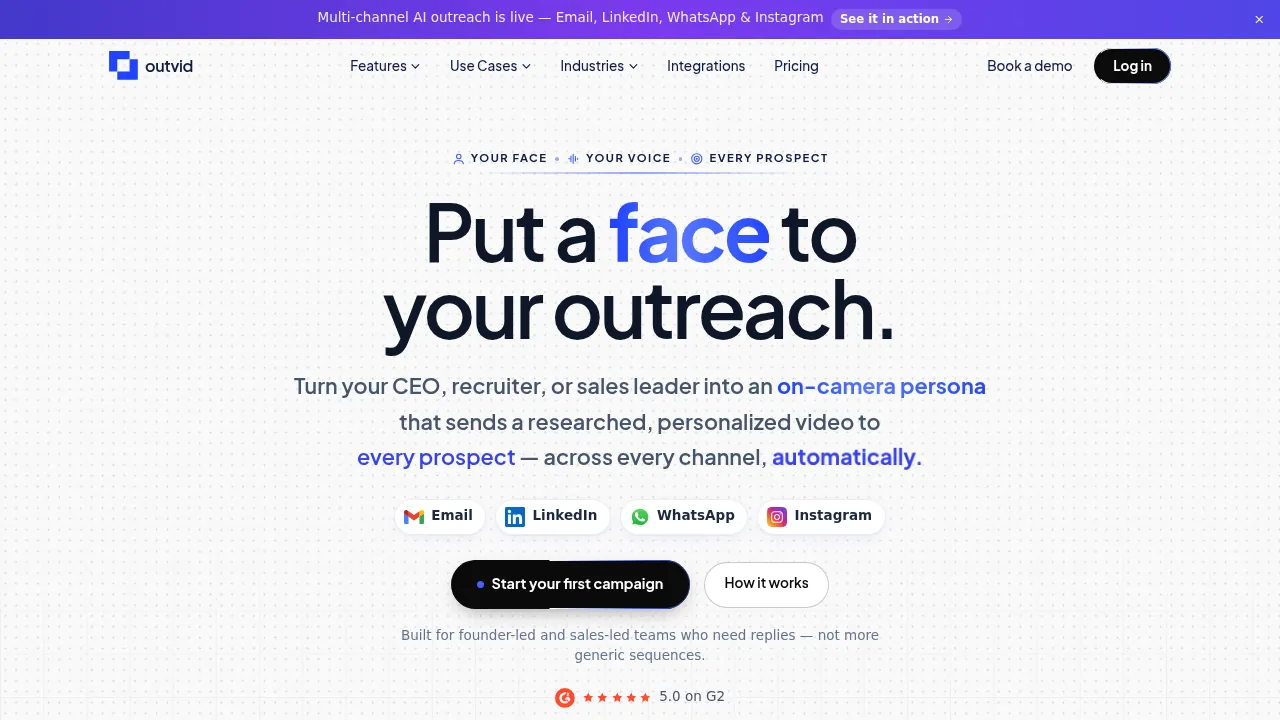
Outvid is built around exactly this workflow. A user records one video, trains an AI clone on their face and voice, and the platform generates individualised versions for each prospect. Before the video is even made, Outvid's AI researches each contact using LinkedIn activity, funding events, hiring signals, news and product launches, then generates a per-prospect script grounded in that context. The result is a message that feels genuinely one-to-one, even when it's being delivered to hundreds of people simultaneously.
Campaigns run across email, LinkedIn, WhatsApp and Instagram from a single workspace, with reply detection that automatically pauses follow-up sequences the moment a prospect responds. That last feature alone removes one of the most common complaints about outbound automation: the awkward follow-up that lands after someone has already replied.
Where to use video in your outreach sequence
Video works at multiple stages, not just the first cold touch.
Cold outreach is the most obvious use case. A personalized video in an initial email or LinkedIn message immediately differentiates you from the other twelve people who reached out that week with a text-based pitch.
Follow-ups are where many teams miss an opportunity. A second or third touch that includes a short video referencing the original message ("still thinking about what I sent last week?") converts better than a plain "just bumping this up" email.
Re-engagement is underused. Dormant accounts and churned customers respond well to video because it signals effort. A thirty-second video that acknowledges the gap and introduces something new lands very differently from a mass re-engagement email.
Post-meeting follow-ups using video to recap key points and confirm next steps can materially reduce the number of deals that go quiet after a call.
Measurement: what to track
Reply rate is the primary signal, but it's not the only one worth watching. Watch rate (the percentage of recipients who actually played the video) tells you whether your subject line and thumbnail are doing their job. Completion rate (how many watched to the end) tells you whether the content is landing. Meeting conversion rate closes the loop on whether the whole approach is actually generating pipeline.
If watch rate is low but reply rate is reasonable among those who watched, the problem is the thumbnail or subject line. If watch rate is high but completion rate is low, the video is too long or loses momentum early. These are fixable variables, and tracking them consistently is what separates teams that improve from those that plateau.
For teams wanting a thorough comparison of tools before committing to a platform, Outvid's alternatives page breaks down how AI-native sales video platforms differ from general-purpose tools like Vidyard or Loom. And if subject line performance is a bottleneck, the sales email subject line guide covers tested patterns specifically for video-containing emails, including formats that consistently outperform plain-text alternatives.
Video outreach isn't a novelty tactic. With the right research, a credible hook, a clear ask and the infrastructure to deliver it at scale, it's one of the most reliable ways to generate replies from prospects who've learned to ignore everything else.
Frequently asked questions
What is video outreach?+
Video outreach is a sales technique where reps send short, personalized video messages to prospects instead of plain text. The prospect sees a real face and hears a real voice referencing their specific situation, which builds trust faster than text and pattern-breaks a crowded inbox. It works across email, LinkedIn, WhatsApp and Instagram, and AI tools now generate a unique per-prospect video from a single base recording so it scales beyond one-to-one.
Does video outreach get more replies than cold email?+
Yes. Vidyard's research found 63% of sales professionals report that video messaging directly increases their response rates, and SyncGTM data shows teams using personalized video outreach see roughly 25% higher reply rates than text-only cold email sequences. The lift comes from a real face, visible personalization, and a clear low-friction ask.
How long should a video outreach message be?+
Keep it under 60 seconds. Vidyard reports 65% of viewers finish a business video when it runs under a minute, and completion rates climb further at 30 seconds. A practical formula: open with the prospect's name and a specific reference (10s), explain the relevant context or problem (20s), then make one clear ask (10s).
How do you do video outreach at scale?+
Manual recording caps out around 10–20 videos per rep per day. To scale, platforms like Outvid let you record one base video, train an AI clone on your face and voice, and auto-generate a personalized version for every prospect — each grounded in per-prospect research (LinkedIn activity, funding, hiring signals, news). Campaigns run across email, LinkedIn, WhatsApp and Instagram with reply detection that auto-pauses follow-ups once a prospect responds.
About the author
Leon Zay writes about AI video outreach and modern B2B sales for Outvid — the platform that lets sales and recruiting teams send a personalized video to every prospect from a single base recording.
Explore related topics
More from the blog
January 30, 2026 · 6 min read
Video Email vs Text Email: Which Gets More Replies? (2026 Data)
We analyzed thousands of outbound campaigns to compare video email and text email performance. Here's what the data says about open rates, reply rates, and conversions.
January 15, 2026 · 10 min read
Best AI SDR Tools in 2026: A Comprehensive Comparison
An honest comparison of the top AI SDR tools in 2026, including features, pricing considerations, and which is best for different team sizes.
June 17, 2026 · 9 min read
Synthesia for Outbound Sales: Does It Work? (2026)
Can you use Synthesia for outbound sales and cold email? Where it fits, where it breaks for true 1:1 prospecting, and the best outbound-native alternative.
Ready to scale your outreach?
Record one video. Send researched, personalized versions to every prospect — across every channel.
Alex Masson
PromotionsQuick question about your pipeline
Hi there, I came across your company and wanted to see if you're open to a quick 15-minute call about how we help teams...

Your Name
Video MessageMade this video for you, Marcus

Hey Marcus, saw Northwind just opened its second site, congrats!
Click to watch your personalized video →