Leon Zay · June 17, 2026 · 9 min read
Synthesia for Outbound Sales: Does It Work? (2026)
Can you use Synthesia for outbound sales and cold email? Where it fits, where it breaks for true 1:1 prospecting, and the best outbound-native alternative.
Yes, you can technically use Synthesia for outbound, but it is built to produce studio-style avatar videos, not to run 1:1 cold outreach, and that gap costs you reply rates. Synthesia is an excellent AI-video creation studio for training, internal comms and multilingual marketing. It does not research prospects, send messages, sequence follow-ups, detect replies, or manage deliverability, so on its own it cannot run an outbound motion.
This matters because the job of outbound is different from the job of producing polished video. Cold outreach needs a unique message per prospect, native multichannel delivery, sender-reputation controls and reply handling. Synthesia's "personalized video" is templated variable substitution from a spreadsheet, not per-prospect research and scripting. And in 2026, fronting cold messages with a fully synthetic avatar carries a trust cost that buyers increasingly notice.
What follows is the direct answer first, then where Synthesia genuinely fits, where it breaks for outbound, and what to use instead if your goal is replies and booked meetings rather than rendered video assets.
Used by sales teams running modern outreach







Can you use Synthesia for cold email and outbound sales?
You can use Synthesia to create avatar videos for outbound, but it is not an outbound platform, so you would have to bolt it onto a separate sending stack, and its own Acceptable Use Policy explicitly prohibits spam and unsolicited promotions. Synthesia generates videos; it does not source prospects, send email or LinkedIn messages, run sequences, or track replies. The actual outbound work happens somewhere else.
In practice that means a workflow like this: build a video template in Synthesia, export share-page URLs, push them into your CRM or an email tool via Zapier, then send and follow up using a separate sequencer. Synthesia is the content-production component, not the engine. Its own blog frames video as an enhancement to outreach, such as a post-webinar follow-up reached through integrations, rather than initial cold prospecting.
There is also a policy flag worth taking seriously. Synthesia's Acceptable Use Policy bans "unsolicited communications, promotions, or advertisements, including spam," and restricts using stock avatars in ways that imply the real actor endorses your message to Enterprise plans. For mass cold outreach fronted by a stock synthetic presenter, that is the single most important clause to read before you build a programme on top of it.
Is Synthesia good for sales videos?
Synthesia is genuinely good for one-to-many sales content like internal enablement, explainers, product walkthroughs and multilingual marketing, where one polished avatar video is reused across many viewers. It is marketed to roughly 60,000 companies and, by its own claim, around 90% of the Fortune 100, primarily for learning and development and corporate communications. Independent reviewers consistently rank its avatar realism at or near the top of the synthetic-avatar category.
Its real strengths are scale and breadth. Synthesia supports 160-plus languages and accents backed by 1,000-plus AI voices, so any avatar can deliver any script with lip-sync across locales without a reshoot. For a global team producing the same explainer in fifteen languages, that is a serious advantage, and it is exactly the kind of high-volume, repeatable content the platform is designed around.
The distinction that matters for sales is the audience model. A great enablement video is an asset; a great cold-outreach video is a message. An asset gets better with production polish and reuse. A message gets better with relevance, recency and the unmistakable sense that it was made for one named person. A sales-enablement clip or a demo that hundreds of prospects will watch is a strong fit; a cold first-touch video that must feel written for one specific person is a different job, and that is where the category mismatch begins. If you are weighing video for the top of the funnel, our take on why video outreach beats text-only AI covers what actually moves replies.
Does Synthesia make personalized 1:1 videos for each prospect?
Synthesia produces templated personalized video through variable substitution, not true per-prospect 1:1 video. You upload a CSV or spreadsheet, map columns to template variables such as name, company and role, and each row generates a distinct video, but every video is the same template with swapped fields. There is no per-prospect research and no AI-generated bespoke script for each individual.
That is an important and widely misunderstood distinction. "Personalized" in Synthesia means the depth of whatever data you already put in the spreadsheet. If your CSV holds a first name and a company name, that is the extent of the personalization. The video does not know why this prospect matters, what they recently announced, or what problem your product solves for their specific situation, because nothing in the pipeline researches them.
True 1:1 outbound video works the other way around. It starts from research about the individual, a recent funding round, a new hire, a product launch, a LinkedIn post, then writes a script grounded in that context, then renders the video. The depth gap is not cosmetic: McKinsey has put the business value of getting personalization right at a 5 to 15% revenue lift, and in a cold inbox the difference between merge fields and genuine relevance is the difference between a reply and the archive. That research-to-script layer is the part Synthesia does not include, and it is the part that makes a cold video feel like it was made for one person. We unpack the mechanics in personalized video at scale without recording hundreds.
Does Synthesia integrate with my CRM or sales sequence?
Synthesia integrates with tools like HubSpot, Salesforce and Mailchimp through Zapier or Make to insert a video asset into a workflow, but it does not run campaigns, send messages, or sequence follow-ups itself. The integration drops a finished video into a process that something else operates. Synthesia is not a sending platform, so the entire outbound engine still lives outside it.
Concretely, here is what is absent natively: no prospect research or enrichment, no email, LinkedIn, WhatsApp or Instagram sending, no multi-step sequences or cadences, no reply detection or inbox, and no deliverability controls such as mailbox warmup, SPF, DKIM, DMARC, domain rotation, send-window throttling or per-account limits. Reviewers who cover outbound consistently route buyers who need prospecting, sequencing and CRM-native sending to dedicated outbound tools, and Synthesia does not appear on those lists.
This is the most under-explained gap in most write-ups about Synthesia for sales. They say it "doesn't connect to your pipeline" without spelling out that the pipeline, sequencing, reply handling and sender reputation are all things you must build or buy separately. Deliverability is where bolted-together video outreach quietly fails: embedding video badly, sending from cold domains, and ignoring per-account limits is how campaigns land in spam regardless of how good the avatar looks. The thumbnail itself can help once you reach the inbox, Wistia's testing across seven A/B email tests, run in 2017, found a video thumbnail with a play button drove an average 21.5% lift in clicks over a static image, but a standalone video asset is the easy 10%; the deliverability, cadence and reply logic are the hard 90%.
Do AI avatar videos hurt cold outreach reply rates?
In cold first-touch outreach a fully synthetic avatar can dent reply rates, and the broad signal behind that is AI-content fatigue. A Gartner Marketing Survey published in March 2026, based on 1,539 US consumers surveyed in October 2025, found that 50% of consumers would prefer to give their business to brands that do not use generative AI in consumer-facing content. A separate Gartner survey from July 2024 found 64% of customers would prefer that companies did not use AI for customer service. The market is moving toward, not away from, demonstrable human authenticity.
The mechanism is structural. Outbound is decided on trust and relevance, and a recognisably generated presenter starts at a deficit on both. Buyers in 2026 have developed a sharp instinct for spotting AI avatars, and commentary across the category describes growing scepticism toward deepfake-style avatar videos in cold prospecting. Importantly, this is not a quality complaint: synthetic avatars are not failing because they look bad, the best ones look remarkable. They are disadvantaged because the cold inbox rewards authenticity, and a generated stand-in is structurally weaker on authenticity no matter how polished the render. That is a category fact, not a knock on the technology.
Be careful with the headline numbers floating around this topic. Claims like "AI avatar video lifts open rates 85%" or "3.2x more responses" come from vendor marketing blogs without published methodology, and open rate itself is an increasingly unreliable metric after Apple Mail Privacy Protection inflation. The defensible, source-backed takeaway is the one the evidence supports: transparency and a real human face build trust, and the market is shifting toward real video of the actual salesperson combined with AI personalization, rather than away from real faces.
What is the difference between an AI avatar and an AI clone for outbound?
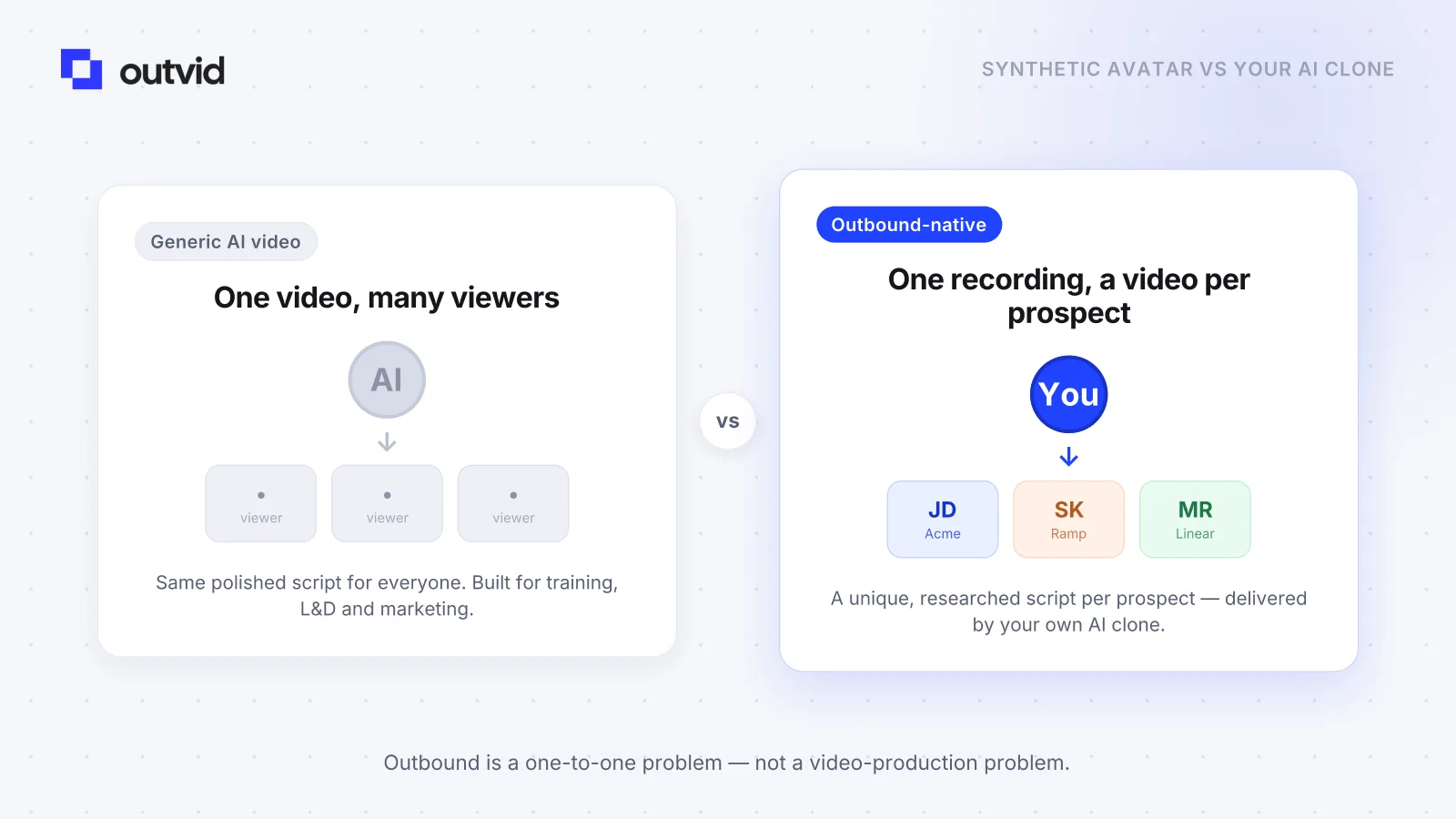
An AI avatar is a synthetic, generated presenter, either a stock library character or one customised from a photo, reading whatever script you give it; an AI clone is a model of your own real recorded face and voice delivering a message as you. For cold outreach the difference is decisive, because the prospect is deciding within seconds whether a real person actually reached out to them.
Synthesia's avatars sit firmly in the first category. Its photo-based avatars are, in its own documentation, speech-driven animation rather than a real performance, and stock avatars represent paid actors whose likeness carries its own consent and endorsement restrictions. The output is impressive video, but it is still a generated avatar rather than camera footage of the actual sender, and that is the attribute most relevant to trust on a first touch. That matters because Vidyard's State of Virtual Selling research (2021) found over 70% of sales professionals say custom-recorded video produces better opens, clicks and responses than text, and the operative word is custom: it is their face, not a synthetic one.
The outbound-native approach inverts this. Instead of a synthetic presenter reading a mail-merged template, you record one real video, the platform trains a clone on your genuine face and voice, and it generates a per-prospect version where the words change but the person is unmistakably you. That is the category Outvid is built for, and you can see how the clone itself is created in our AI clone setup guide and on the AI clones feature page.
What is the best Synthesia alternative for outbound sales?
If your goal is replies and booked meetings rather than rendered video assets, the best alternative is an outbound-native AI-clone platform that researches each prospect, writes a unique script, generates a per-prospect video as you, and sends it across channels with reply handling built in. This is not Synthesia doing outbound badly; it is two products built for two different problems. Synthesia is the right tool when the deliverable is a polished video; it is the wrong tool when the deliverable is an outbound campaign that runs end to end.
Outvid is built for exactly that job. It clones your own recorded face and voice, then before any video is made it runs deep agentic research on each prospect across six or more public sources, funding events, hiring signals, news, LinkedIn activity and product launches, and writes a per-prospect script grounded in that context. Each prospect gets a unique script and a unique video, not a template with a swapped name. You calibrate on two to five sample scripts, then run the campaign hands-off.
Crucially, the sending and follow-up logic that Synthesia lacks is native here. Campaigns deliver across email, LinkedIn, WhatsApp and Instagram from one workspace through Smart Campaigns, and reply detection automatically pauses follow-up sequences the moment a prospect responds, so nobody gets an awkward bump after they have already replied. Credits are tier-capped, which nudges the motion toward selectivity over spray-and-pray volume. You can compare the two directly on the Outvid vs Synthesia page, weigh the wider field on the alternatives hub and the Vidyard alternatives breakdown, or see the research layer on the prospect research feature page.
How much does Synthesia cost for sending sales videos at scale?
Synthesia is priced per editor seat plus a monthly video-minutes allowance, which makes it economical for producing a fixed library of content but awkward for high-volume outbound where every prospect needs a fresh video. The free tier caps at roughly three minutes a month; paid tiers add more minutes and personal-avatar creation, and Enterprise unlocks unlimited minutes and the broader usage rights. Prices have moved around in 2026, so verify the current numbers directly.
The structural issue for outbound is the minutes model itself. Outbound thrives on a unique short video per prospect, so a list of 300 prospects is 300 separate renders, and a per-minute cap turns volume into a metering problem rather than a research-and-relevance problem. Tools built for content production optimize for reuse; tools built for outbound optimize for per-prospect distinctness, and the two pricing philosophies pull in opposite directions.
When you do the maths on cost at scale, the real question is not the per-minute rate but whether the platform also handles everything around the video. If you are paying for a video studio and then separately for research, sending, sequencing, deliverability and reply tracking, the video is the cheapest line item. An outbound-native platform folds those into one motion. To pressure-test the return before committing, the measure video outreach ROI guide and the Outvid pricing page are the practical next reads.
What should you actually do?
Use Synthesia for what it is excellent at, and use an outbound-native platform for outbound. If you are producing training, enablement, explainers or multilingual marketing video, Synthesia is a strong, defensible choice and there is no need to look elsewhere. If you are trying to book meetings from cold prospects, it is the wrong category, because the hard parts of outbound, research, per-prospect scripting, multichannel sending, deliverability and reply handling, are not what it does.
The honest framing for 2026 is that the question has shifted from "do video and avatars work" to "does this feel like a real person who actually researched me." Templated avatar video struggles on that test; a researched, one-to-one video delivered as your real self passes it. The inbox is not judging your production values; it is judging whether a real person who clearly did their homework reached out. With consumer scepticism toward generative AI rising, the teams that win on video will be the ones that lead with authenticity and relevance, not rendering volume.
If you want the outbound motion in one place, start with the AI clone setup guide to record your clone, then review the Outvid vs Synthesia comparison to see the category difference laid out feature by feature. The goal is not a prettier video; it is a message a prospect believes was made for them, sent through a system that follows up intelligently and stops the moment they reply.
About the author
Leon Zay writes about AI video outreach and modern B2B sales for Outvid — the platform that lets sales and recruiting teams send a personalized video to every prospect from a single base recording.
Explore related topics
More from the blog
January 18, 2026 · 8 min read
11x AI vs Artisan vs Outvid: Which AI SDR Is Right for You?
A detailed comparison of three leading AI SDR platforms — 11x, Artisan, and Outvid — covering features, pricing approach, and ideal use cases.
January 24, 2026 · 6 min read
Why Video Outreach Beats Text-Only AI: The Science Behind the Format
The psychological and behavioral reasons personalized video outreach earns higher reply rates than text-only AI emails — and how to capture that advantage.
June 2, 2026 · 9 min read
Multichannel Outreach Sequences: How to Combine Email, LinkedIn, WhatsApp & Instagram
Single-channel outreach leaves replies on the table. Multichannel sequences that branch across email, LinkedIn, WhatsApp, and Instagram based on prospect signals consistently out-reply email-only campaigns. Here's how to build one.
Ready to scale your outreach?
Record one video. Send researched, personalized versions to every prospect — across every channel.
Alex Masson
PromotionsQuick question about your pipeline
Hi there, I came across your company and wanted to see if you're open to a quick 15-minute call about how we help teams...

Your Name
Video MessageMade this video for you, Marcus

Hey Marcus, saw Northwind just opened its second site, congrats!
Click to watch your personalized video →